
Measuring How Fast Helium-Filled Balloons Rise
Experiment #3
This activity is designed for the classroom. Helium-filled latex balloons should have lengths of light thread attached, long enough to reach from the floor to the ceiling. (Balloons can be filled with helium inexpensively at card and gift shops the afternoon before you plan to do the experiment.)
Getting Started:
S how the class a helium-filled balloon and let it go so it rises to the ceiling. The activity raises questions about why the balloon rises, how fast it goes up and when it will come down. Let the children discuss the questions and propose experiments to test the concepts of gases in the atmosphere. You can suggest the following activity.
Measuring Rate of Rise:
Give each group of children a helium-filled balloon. Each group should have one child who calls out the time of release and the time the balloon reaches the ceiling; a child who releases the balloon on signal; a child who counts down “3, 2, 1, Go,” and children who call “now” when the balloon reaches the ceiling.
Time can be measured with a clock or watch with a sweep second hand, a digital clock that measures seconds or a stopwatch.
Have one group demonstrate how to hold the balloon at floor level, release it, and measure and record the release time and the time it reaches the ceiling. (If your room has a low ceiling, you may want to do this activity in the gymnasium.)
Now, have each group measure the rate of rise of its balloon. Did all the balloons rise at the same rate? Have the children suggest explanations.
Changing Rate of Rise:
Helium-filled balloons gradually lose helium, as the children observed in the permeability experiment. Have them measure the rate the balloons rise as they get smaller — and record the circumference each time.
Adding weights will change the rate of rise. The children can attach large paper clips to the string at the neck of the balloon and measure the rate of rise with 1, 2 or 3 clips. How many clips does it take to make the balloon float level — neither rising or falling?
What Happens to Balloons that Keep Rising:
If a helium-filled balloon floats away outdoors, what happens to it? Balloons rise into the atmosphere where the pressure and temperature decrease with altitude. Data from the National Weather Service show that at a height of five miles and air temperature of minus-40 degrees F balloons blow apart into small pieces. The natural rubber actually shatters due to the combination of high pressure and cold.
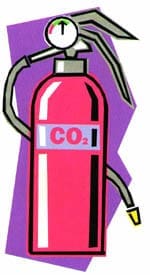 When the balloon bursts at the five-mile altitude, the balloon ends up as tiny spaghetti-shaped slivers of latex. Although it is impossible to recreate this process exactly, the shattering of helium-filled balloons can be simulated in the classroom by using a CO2 fire extinguisher. The CO2 inflates the balloon at a much lower temperature than helium and when it reaches the bursting point, shatters most of the balloon into thin strips of latex.
To demonstrate this, you or a group of students can attach the balloon over the nozzle of the CO2 tank, press the handle and when the balloon inflates to its bursting point, it’s important to stand behind the fire extinguisher. If they are available, students can wear safety goggles during the experiment.