Pussycat Express
| Race Order |
Entry # | Driver Name | Car Name | Mass (grams) |
Length (inches) |
Width (inches) |
Height (inches) |
Distance Traveled (feet) |
Running Time (seconds) |
| 20 | 41 | Dina MacNeal | Pussycat Express | 17 | 11 | 6 | 4 | 15.33 | 5.86 |
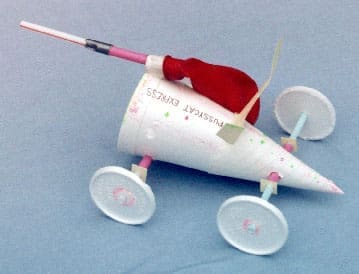
Balloon car designer Paul MacNeal writes for his daughter Dina:
- Design approach taken – explain how it worked.
She chose to utilize a single balloon as a thrust jet and make the vehicle
as light as possible. - Unique or clever features embodied
My best feature was the wheels and axle system. The wheels were constructed
from thin cardstock. The circles were cutout and then shaped and glued into
shallow cones. Two cones were glued edge-to-edge to complete the wheel.
The axles were simply straws. She chose to have the wheels fixed to the
straws with the axle freely rotating inside another, larger diameter straw.
The axles were prevented from moving side-to-side by thin cardstock washers
glued to the moving axle.To keep the balloon from moving side to side, a support was made from cardstock.
To keep the vehicle from tilting upwards (caused by wind resistance of the
balloon), a rock was glued to the front end of the car. - Materials of construction (mention unique parts you used or fabricated)
Axles were plastic straws.
Wheels were cardboard.
Body was a styrofoam cup and paper.
Rock used for ballast. - Reasons behind any significant design choices you had to make
The original nozzle was too large for the balloon. Early testing had the
16 gram vehicle popping wheelies and falling over on its side after spinning
in circles due to too much thrust. A reduced diameter straw was implemented
to provide a more stable thrust. - Lessons learned (what you’d do differently next time)
Spending more time choosing the size and length of�the exit port (nozzle)
could have allowed a faster vehicle which would lead to a farther distance.
MB 1/9/99