
Balloons and Teaching
When teaching, we have found that there were always one or two kids who seemed to be naturals at balloons.
– Unknown
- Teaching Children to Twist Balloons
- Teaching Adults to Twist Balloons
- Suggested Curriculum Ideas
- Using Balloons as a Tool for Demonstration
- Balloons as Rewards
Teaching Children
- Teaching Children to Twist Balloons (or, “It’s a Dog’s Life”)
- Teaching Elementary School Children
- Teaching Handicapped Children
- Teaching Children to Decorate with Balloons
- General Advice
Teaching Children to Twist Balloons (or, “It’s a Dog’s Life”)
- Let’s face it, balloon sculpture isn’t rocket science: it’s easy, it’s fun, and it beats doing drugs. That’s why we all started doing it. So why not spark interest and pass it along to a new generation? We all started with a simple dog, some of us got hooked, and here we are. It’s no accident that I call my short video pieces on balloon animals “Any Clown Can Do It.” But at the same time, nobody is going to make a three-twist dog and say, “Hey, I’ll twist for the kids next year” (well, if they do, bet your boots they’ll call you back the *following* year).
- I teach kids how to make a simple animal (their own three fold dog). After that I make them each a balloon animal of their choice. I discovered that when they made their own animal first, they were less likely to take apart the one I made for them. I want kids to know that anybody can make a balloon animal. It’s like playing the piano – everybody doesn’t have to be Rachmaninoff to enjoy playing chopsticks. And playing a little bit of piano makes you appreciate the great masters even more. Making an animal is a real esteem builder for kids. It’s a safe, silly way for them to be successful at an artistic endeavor. If they can be successful at this, maybe they can try drawing, sculpting, or something else that’s creative. You may actually give a child the gift of a lifetime hobby or career just by teaching an 8-year-old how to make three loop twists. We have to keep in mind that the act of making the animal is simple. What makes a great twister is practice, good lungs, practice, shared ideas, practice, a winning smile, practice, charming patter, and practice. Teaching kids how to make an animal doesn’t take away the mystique of your performance; it gives them a new appreciation for it.
- It’s like a cooking demonstration. Anyone can make a cake, but why do I keep going back to La Patisserie? Because for 20 bucks I get a really *good* cake. If you’ve picked up a tennis racket and batted a few balls over the net, you have a better appreciation of what it takes to be a professional tennis player. Any of us who have drawn a picture have a better appreciation of what it takes to be a great artist. There are dabblers (like me) and maestros (like Bruce), and all levels of skill in between.
- Another big hit with older kids (7+) is to teach them how to make their own three-twist dog. I’ve done this a couple of times at school carnivals. For 50 cents, I give them a bag of 5 balloons with a xeroxed set of instructions for the basic dog. I show them how to blow up the balloon and guide them through the 3-twist dog, then the standard dog. You’ll have to blow up the balloon for some of the kids, but they’re really thrilled with the balloons they make themselves.
- Inflate enough balloons for the workshop, but also give the kids a couple of uninflated balloons to take with them. I give each kid a baggie with 5 balloons in it, and collect either 50 cents if the balloons are donated or a dollar when the fair pays for them.

- Teach them to make a three fold dog and have a prize for the best one. Have “them” make a free form sculpture and have them vote on the one they like best.
- Teach them to twist their own three-twist dogs. This will give them an appreciation of your art and give them something to hold while they’re waiting for a special sculpture from you.
- Bring preinflated balloons and teach the kids to do a three twist dog. Bring more balloons and they can make hats and all sorts of figures that are very easy. It keeps them involved and they love stuff they have made themselves.
- I’ve found that teaching kids to make their own three-twist dog is a great way to handle big crowds.
- One thing I do differently, though, is photocopy the instructions for creating a standard dog (with all the pinch twists), with variations like the giraffe and elephant. I put the instructions and five balloons into a plastic bag and charge the equivalent of a dollar’s worth of tickets. That way, you don’t have to worry too much if someone pops one, it gives them a chance to practice a couple of times, and they walk away with something they can use next week. I let them know that they can purchase more balloons at party stores, etc. And, of course, http://www.fooledya.com/balloon is on the instructions so that they have someplace to go once they get bitten by the bug.
- I had 6 kids in a beginner session this morning (it’s an art class, not a balloon class), so I was able to pump and tie for the whole group. That was pushing it, because they got kinda bored for a minute while I finished up. If you have many more than that, you’ll need help, or inflating and tying will have to be the first lesson. It took about 15 minutes to demonstrate each figure. Some kids were much faster than others, but they were pretty patient while the others caught up. We did three sculptures this morning. More kids will take longer to help.
- For smaller parties I take a couple of extra pumps and let the kids share these and a handful of balloons. Of course the first few they try to blow up will fly all over the room till they learn to hold on to the balloons while they pump. Then some of these kids will be a big help finding different colored balloons for me and even doing some of the inflating while I twist. And some even learn to make strange concoctions of twisted ballons for themselves. Extra markers let the kids put wild notes and faces on the balloons for themselves. Little girls like to make rainbows and faces on hearts.
- I give each child a balloon (3/4 filled) and teach them how to make a dog. Sometimes, instead of this, I put a pile of 3/4 inflated balloons on the floor and have the children work together to make one large sculpture.
- I take a pump and a half of a gross of balloons per guest. They get to keep the balloons. I take the pumps back at the end of the party, or they can be added to the price of the party if the hostess wants to purchase them for the children. Both times it was decided that the hostess would let the children decide if they wanted to keep the pumps, and if so she would pay for them. Both times they kept the pumps. The way I taught them was to sit everyone in a circle and get three balloons blown up and ready before we started a creation. Then we did one step at a time making sure that everyone was following. If there was a pop I would catch that person up to the rest and we would go on. I heard later from the parents that they got really creative after I left and had hours of fun.
- When teaching balloons to kids I like to give out balloons for them to just create, after they’ve had a chance to do the dogs. I give them the option of creating something with their one balloon or working with others to put a bunch of balloons together. While presenting, I do one or two large figures for them to see, so they have many ideas to work with.
- Give them a set of hand-drawn instructions for creating the basic dog, and changing it into other critters. Even if they don’t succeed there, they can practice on their own.
- Tell them where they can get more balloons and where they can find books about twisting.
- I find that kids can make balloon creations better with 130’s than the 260, their hands are smaller. I pre-inflate the balloons and bring hand them out to let the kids learn to make a dog, cat, or whatever. One attempt mouth-blowing a 130 and the kid will go for the pump. This keeps the balloon out of their mouth as well.
- I have found it to be a great help to some of the kids if we use 160’s, instead of 260’s, due to hand size and strength.
- All of the balloons must be the same color when teaching children. This does not mean you can’t have more than one color. I pre-inflate for my kids classes and use several colors. However, each sculpture that I teach is made with the same color balloon. I keep them segregated by length, and all balloons of that length are the same color. Too many arguments and whines have taught me this.
- Other than a 3 fold dog, there are a lot of figures which only need a fold twist or an S twist. These are easy figures for kids to make.
- Put the dog on a 260 leash.
- Hats – First give a warning about not making elephant trunks (they can pop and snap you in the eye). Show them how to make a basic hat, then give them 3 or 4 balloons and look out.
- A 4 petal flower.
- A heart in a basket/pacifier/heart hat (You tie the heart to the 260).
- A sword and scabbard – “S” twist sword or pirate type sword.
- A laser gun.
- A simple alligator.
- A heart hatchet.
- A heart on a stick.
- A Bee or Hummingbird.
- The Twisted Wrister with a heart, dog, or smiley balloon on top.
- The Spear – they could help each other to wind 2 balloons.
- A ball could be pre-loaded into either of these last two, to make it more interesting but more work for you.
- Make your own juggling balls from 9″ round balloons and birdseed, and use the making of same as a class for the kids.
- I’ve been making my own juggling balls for years, but I’ve given up on bird seed. Seed has a couple of potential problems. First, it can sprout. Second, little furry critters can show up in your juggling bag and tear through the balloons to get the food inside. I’ve had both of those happen. My recommendation is crushed walnut shells. I haven’t had any problems with that, and I actually prefer the feel of it in the juggling bags anyway. You can find crushed walnut shells in pet stores as small animal walnut bedding.
Teaching Elementary School Children
- Kids love to help you twist. You do the nose, set up the ears and let the kids do the twist. Same for the front and back legs. The kids feel as if they did the animal. It’s great fun. we have done it several times.
- I have found that kids love making balloon animals too. I’ve put this to my financial and artistic advantage by actually teaching them to twist. I have contacted several elementary schools in my area offering them a balloon sculpting course for kids in grades 3 through 6. This class usually comes under the heading of after school programs or artistic education. Parent/ Teacher Organizations will usually fund these classes.My class runs six weeks and has a maximum class size of 10. I get a teaching fee and the parents pay extra for supplies (hand pump and 1 gross 260s). I start by talking about balloons, safety, the environment, do demonstrations of blowing and tying and work the class up to twisting their first mouse. By the end of six weeks the kids are making teddy bears, fruit baskets and even the pink panther, if they are really good.Teaching kids to twist helps them with manual dexterity, self esteem, and even structural engineering. I almost always have full classes and have even had kids go on to do birthday parties for friends and siblings and cousins. Nothing makes a kid happier than earning $10 at a party so he can buy another bag of balloons. Its a blast! Its great to run into the kids months later, they will tell you or even show you how much they remember!
Remember, it’s not competition, it’s good will and good publicity. I can’t tell you how many jobs I’ve gotten as referrals via teaching. Give it a shot if you have a free afternoon each week.
- How you use balloons will depend on your grade level. With the younger kids, there’s plenty you can do when you teach about animals. What does a platypus look like? Oh, like this? No? what do you mean there aren’t enough legs? What’s different between this balloon animal and the picture?
- We did counting exercises in kindergarten with balloons. We filled the room with 100 balloons of different shapes on the 10th day of school. Then we counted how many of each shape we had. After we twist them, the shape is changed, but the count is the same. We also identified colors and practiced fine motor control when we made dogs. We told stories that involved balloons. The kids can get quite creative.
- The other day one little girl, perhaps 8 years old or so, seemed particularly interested in watching the animals etc. being created. When I see an attentive kid and circumstances permit, I’ve found it’s fun and rewarding to inflate two, hand one to the kid, and teach the basic beginner’s dog. When I handed her my Sharpie to decorate the face, this kid put eyes on her new creation better than any I’ve ever drawn. I’ve drawn them her way since then.
- I’ve done twisting workshops at two elementary school art fairs in the past year. I start with the three-fold dog, and then teach the improved dachshund mit dem pinch-twist ears and legs. After I’ve shown the basic dog, I go on to demonstrate how to exaggerate features to turn it into a rabbit, giraffe, etc. I tell them they can try to keep up if they like, but I do it fast just to show them what’s possible. It’s a good way to get kids started, and it shows them a number of figures they can make right away.
Teaching Handicapped Children
Marvin L. Hardy, CBA writes:
- I have had the privilege of working with the blind on several occasions, and it is one of the most challenging, yet rewarding activities I have ever participated in. Penny and I started in Utah with a fantastic group of young blind children – Elementary School to High School ages. We were very un-successful the first couple of attempts. It was Penny’s observation that I was describing sight to people who could not see. She blindfolded me, and I worked for several weeks before I could comfortably do any of the figures I do, even to the large woven sculptures, without looking. I regularly do figures blindfolded as a part of the shows that I do.
- Penny and I recently taught a balloon figure class at the Seattle Central Community College to a group of 23 deaf and blind adult students. The students were both deaf and blind, and each had an interpreter working with them. I would demonstrate and describe each step, an interpreter would then translate into sign language for the individual interpreters, and they would sign for the students. Each student would feel the signs of the interpreter and then do the step. It was awesome. We took three other twisters with us and that helped to give personal attention to the students, but we realized that it would have better if we had a twister with each student.
Teaching Children to Decorate with Balloons
 Wynn and Lindy Bell write:
- We are visiting one of our local schools and presenting an hour and a half workshop to the 4th grade classes on how to make a “Fantasy Flower” bouquet for a Mother’s Day present. During the first 10 minutes of the class, we’ll take the time to talk with them about the environmentally safe balloons they will be using, as well as showing them some of the different uses there are for balloons. We’ll have our portfolios available, and we will also distribute the comic books put out by the Balloon Council. The teachers absolutely love having us there, and the kids (and US too) always have a great time. I recommend doing this for no one younger than 4th graders (and 5th graders might be better). There is very little cost to us; we use some of our leftover 5-inchers, some duct tape (floral tape is too hard for them to use), and some florist wire.
General Advice
- It’s a good idea to have an “assistant” who can give individual when needed, to keep the majority of the class moving along.
- When teaching, we found that there were always one or two kids who seemed naturals at balloons. Maybe they were just better at the hand-eye thing than the others, but they sped through learning a sculpture way ahead of everyone else. These are the kids you want to be your helpers. Pair them up with someone who may be having a harder time getting a twist. 1) there is only one of you and if someone needs an up close look at how a twist is done, your excelled student can demonstrate 2) Sometimes a student who is having a problem can see better from a pair of smaller hands demonstrating the twist 3) An excelled student may be able to explain how a twist is done in language that his peer can understand better.
- Review the Guide for “What to say when a balloon pops” and other patter. Not only can you pass some one-liners along, you’re going to need a supply to make the kids laugh when their creation pops or turns out cock-eyed.
- If you go to have fun, the kids will too. If you get frustrated or angry, they’ll sense your tension and make it worse. Go easy, don’t sweat it, don’t rush, and it’s a great time for all.
- I tell all my students to bring the largest trash bag they have to class, for transporting their creations home.
Teaching Adults to Twist Balloons
- Beginning, Intermediate and Advanced: Where Do I Belong?
- Beginning, Intermediate and Advanced: Fundamentals
- Beginning, Intermediate and Advanced: Instructor’s Point of View
- How to Best Gage the Average Level of the Class
- Other Things You Need To Know
Beginning, Intermediate and Advanced: Where Do I Belong?
What’s differentiates a Beginner, Intermediate and Advanced twister?
- “Advanced” is a difficult thing to define. There are *simple* multiple balloon sculptures, complex singles, and some simple designs that become elegant with advanced techniques, (getting just the right curve to the swan’s neck, or the dolphin’s tail.) What was “too advanced” when you started may be simple now. I find it challenging to make a multiple balloon sculpture with as few balloons as possible, or a single balloon sculpture as detailed as possible. “Advanced” depends on the sculpture and the sculptor, not the number of balloons used.
- Multi-balloon figures aren’t more advanced than one-balloon figures. I prefer one-balloon figures, myself. I like the challenge of pop-twists and working with a limited amount of balloon to come up with figures.
- I love doing the elaborate, multiple balloon dazzling creations, but it’s a real challenge knowing how much to leave uninflated on your one balloon, multiple bubble creation so that you finish with just exactly the right size bubble at the end, have no excess, and have used it all up!! I heard once that’s the true mark of an ‘advanced’ twister. My hat’s off to all the advanced single balloon figure twisters.
- When I saw Fred Harshberger’s kissing teddy bears several years ago, I KNEW he was going places. Everyone there at convention with Fred that year was amazed that he could make 28 1/4 inch bubbles EXACTLY the same size and end up with the tail on one bear (the first bubble) the same size as the tail on the second bear (the last bubble). This same creation made with larger bubbles and two 260’s is soooo much easier. I also recently learned a great single balloon rhino that with exact specs (and practice) you end up with just exactly the right size tail. It’s a challenge….
Beginning, Intermediate and Advanced: Fundamentals
What twists and sculptures are generally considered “Intermediate”, as opposed to “Beginner”? At what point should a sculpture be considered “Advanced”?
- As I see it, “Beginner” classes start with the fundamentals: materials/ equipment and basic twists, with some designs to illustrate the twists. Intermediate classes continue learning more twists and technique, with more advanced sculptures to illustrate. In Advanced classes, students should already know twists and concentrate on technique and advanced sculptures. Classes may concentrate on specific aspect of advanced balloons, i.e.: cartoon characters, hats, complex single or multiple balloon sculptures, weaves, etc.
- I think “Beginner” classes should teach inflation, tying, basic twists and maybe a few figures to demonstrate what the twists are for. IMHO, Basic figures are those that don’t require exact inflation and bubble proportions to look right. (3 twist dogs, etc..) “Intermediate” classes could then go into more difficult figures: those that require a degree of technique and proportion. Intermediate skills would include pinch and pop, meatballs, spiral inflation and alternate balloons (130’s. geos, hearts, etc…) “Advanced” classes should be multiple balloon and multiple part figures, weaving and characters.
- When doing beginner classes, I think it’s important to cover the “before-basics” (knot tying, pumps, types of balloons, jargon, care, etc) and then to focus on twists. I strongly subscribe to the theory that if you can learn twists and how what effects they have on the balloon (i.e. an ear twist makes a right angle), you can eventually look at a figure and know which twists would be necessary to make it from a balloon, and then see figures as an assembly of twists. I also try to teach how to practice….like blow up half a balloon and make a bubble, ear, bubble, ear, bubble, ear, all the way down, or making series of roll-throughs, or making ‘grapes’ or ‘pearls’ and aim for consistency in bubbles. As I go through twists, I walk them through simple figures that incorporate the twists they learn.
Beginning, Intermediate and Advanced: Instructor’s Point of View
The problems with skill levels and what to do about it.
- The problem I have had with balloon classes is that they seem to gravitate toward the lowest common denominator. The one person in the class who can’t inflate and tie a balloon ruins it for the rest.
- I took a class two years ago from Marvin, at my local distributor. The classes progressed from Basic in the morning, to Advanced in the afternoon. Problem was, most people signed up for all three classes (like they were going to go from beginners to advanced in four hours flat). I found myself helping the people around me catch up, just so that we could get to the next step in whatever figure we were working on.
- From an instructor’s point of view, it isn’t the level of instruction that is the problem; it is the inflated (no pun intended) ego of so many of the attendees. You can advertise a class or workshop as ADVANCED and have people attend who know almost nothing about twisting. You often attract people who have never twisted a 260 in their life but are confident that they can pick it up easily and quickly.
- Nobody considers themselves a “beginner” for more than 2 weeks… especially men… 🙂
- It really doesn’t matter how you break it up as long as it is clearly stated on the flyers, or on a big poster where you sell/take the tickets… of course, they’ll ignore it anyway 🙁
- People will take classes that they don’t have the prerequisites for, because a) they are there, b) it’s your class or nothing, c) there’s nothing like it available back home so they’ll jump in knowing that it’s over their heads, hoping to learn what they can, d) etc, etc.
- People without the prerequisites will always try to crash the advanced workshops, but, if given an option (and your coaxing), they will switch classes when they realize that they are in over their heads. . . which brings me to another strategy: In such a situation, start off with your most difficult figure. This will help you scare off the beginners. Then finish your advanced class with something do- able. That way the students leave smiling, not frustrated (last impressions are important too).
- Somebody had it right when they said that if you’re going to teach multiple classes, and don’t want the beginners mucking up the advanced students, you should:
- Teach the hardest courses first!
- Have an entrance test
- Allow students who fail an entrance test to take a class at a more appropriate level
- The best system I’ve seen was one which offered simultaneous workshops at different levels (using 2 or more teachers), where students were free to migrate between workshops when things got too difficult (or too easy). Have the teacher for the more advanced workshop announce that if students realize they are in over their heads, they can simply get up and switch to the lower level class (the students won’t be upset about wasting money, and you won’t have to slow down and annoy the true Int. level students).
- Advanced people parading past the lower level people (who are waiting for their class to start) with fancy sculptures in their hands provides a “WOW” effect. This makes the newbies eager to continue learning.
- By getting the advanced people there first, there is a chance that some might stay and help the lower level people. You can pick out some skilled people during the advanced workshop, and ask them to stay and help others in the lower level workshops in return for free admission. In dance classes, we offer the class free for anyone taking it the second time around.
- This subject is confusing, mostly because “advanced balloon sculpture” is very different now than it was even a few years ago. The art has progressed far enough that someone that truly taught advanced sculpture years ago can’t get away with the same lecture now. So, I don’t believe defining the terms is the way to go. I will go so far as to say that I either teach a “beginner” workshop that assumes the group has no idea how to do anything with a balloon, or I teach “my” workshop/lecture.Let me explain what I mean by that. I have taught a number of beginner workshops. This is a ‘start from the very beginning’ kind of thing. We talk about inflating the balloon by mouth. A few in the group get it, but I don’t spend time on it. I quickly pass out pumps to give them a chance to try it, explaining that as long as air gets into the balloon it doesn’t matter how. Once they’ve had an opportunity to inflate balloons themselves, I hand out inflated balloons and we move into 3 fold dogs, a more complete dog, a swan, etc. I spend time talking about the properties of the balloon they’re twisting, how much air is in the balloon and other things about balloons.”My” workshop is not aimed at any particular level. Everyone has different interests and pursues different things in ballooning. It’s an art. When I go to a magic lecture, I know who the lecturer is. I try to read some of their material before I go so I know what to expect. I don’t look to see how hard their material is. I look to see if I can learn anything from them. Some of the best lectures I have attended only contained material that an absolute novice could do, but that were full of useful ideas that I’ve never considered. I try to pack my lecture with useful information about balloons in general and teach what I know. If you walk away with a new sculpture or two that you didn’t do before, that’s a bonus. If you walk away with a new way of thinking about balloons, I’ve done my job.
This fits in with what I said about selling yourself rather than selling what you do. I would like to see more people just teach what they think is important/interesting and get off of the topic of defining levels. The definitions will keep changing.
How to best gage the average level of the class, in the shortest possible time, so as to get on with the teaching
- In the past workshops I’ve taught, I’ve tried to gage the level of the group attending, and just continue teaching as much as they can handle, in the time allowed. This is easy with ‘Beginner’ classes, since all your material is new to them.
- The instructor must evaluate the experience of the participants, (which is usually impossible until the class actually starts), and then try to adjust the instruction to fit the class. A good instructor should be able to include enough to challenge the experienced without losing the less experienced. There are times, however, when that is an impossible task.
- You don’t have time to test them individually, so do the sorting as you let them in the door. State the skill requirements VERY specifically at the outset.
- You could glue completed figures to a menu board and say that you need to be able to make all of these to take this class. Stick to your announced level, even if it means you lose some class members in the process. Within this framework, do not teach to the slowest (or the brightest) students in the class! Find the median skill-level and teach 10% above it. That will keep the largest number of students interested, challenged and learning.
- Ask yourself who your students are. If they are all Beginners and Intermediates, you are setting yourself up for disappointment by offering an “Advanced” level class. Also, nobody says that you have to offer “Beg”, “Int”, and “Adv” classes. Offer descriptive course names like “Learning Basic Balloon Sculpture for Fun and Profit,” “Blowing Past the Basics” and “Stretching Your Repertoire” which gives people some sense of what it’s all about without worrying about artificial levels, or requiring them to read much further if they’re not interested.
- If you had the same people for all workshops, you could just take up where the last one left off. But, if this is the case, you should not call the classes Beg/Int/Adv! One beginner class does not an Intermediate twister make.
- Right at the beginning, tell your beginner class members that getting through this class does not make you an “Intermediate Level Twister.” Tell them that they need the course *AND* 20+ hours of twisting under their belts to qualify for that level… so you don’t want to see any of their faces in your next class, because they will slow the class down and the *TRUE* intermediate level twisters won’t get their money’s worth. Same for Int-Adv levels. Repeat it at the end. If you don’t do this, you will end up teaching 3 beginning level classes, and thoroughly annoying all your non-beginner twisters.
Other Things You Need To Know
- Ed Harris has a nice instructional brochure for beginning balloons.
- Tell the students to keep the balloons out of their mouths and warn them about giving balloon animals to small children.
- I absolutely agree about keeping balloons out of the mouths of children. However, I’ve been mouth inflating for 16 yrs and personally am fine with doing it that way; I neither encourage nor discourage students above a reasonable age to do either. The options, pro and con, should be presented though, so personal choices can be made. Check the How to blow up a balloon chapter of the Guide for a list of pros and cons.
- I do review how to mouth inflate properly should that be the choice and thoroughly review available pumps and their use. I also submit that using both is a viable option, as when I b’loon in large amounts (more than 3 hrs at a time or pre-inflate for classes) I use a Pump-O.
- In order to keep things exciting and moving, I pre-inflate all the balloons I expect to use in class. It is a serious amount of work, but the advantages are large.
- The harderst part of twisting is inflating and tying the balloon. While I teach them how I tie a balloon, I don’t expect them to do it during the class. I want them to have such a good experience twisting that they know the payoff is worth the work of inflating and tying. They will learn to inflate and tie at home if they can take home something they are proud of.
- If you have them inflating and tying while you are trying to teach, there will be too much noise and distraction to be effective. You’ll have to wait until they are all ready before you can go on.
- If you have the pre-inflated balloons you have control of when everyone is twisting and when everyone is listening. The balloons are behind me and I control when and which balloons go out into the class.
- I try to intersperse talking and twisting. While what I say is incredibly interesting, what makes the class fun is the hands on twisting. I try to keep the talk short, especially toward the end of the class.
- Most people have a tire pump or a bicycle/basketball pump at home. You can get a nylon nozzle that works with those kinds of pumps at the sports dept. at WallMart or Target. Then there are the palm pumps and the blasters.
Suggested Curriculum Ideas
A Sample Curriculum for a 6 wk Class
Week 1 – One-balloon basics
- Practical lessons:
- Everyone learns basic balloon safety.
- Balloons aren’t for toddlers
- Use a pump (even though many of us started by inflating orally, someone in the class may have a congenital condition and have a stroke trying to blow up their first balloon – don’t risk it).
- Everyone learns to inflate and tie properly
- Basic guess-timation of inflation (how much tail…?).
- Pump operation (including care and maintenance).
- Everyone learns how to twist and lock (you have a chance to start them out right).
- Everyone in the class successfully completes at least one sculpture without assistance. The first hour will go fast.
- Everyone learns basic balloon safety.
- Attitudinal lessons:
- Pops happen, and it’s no big deal.
- Getting the proportions “perfect” isn’t necessary when first learning, and gives the balloon character.
- Speed and accuracy come with practice. Practice, practice, practice.
- Learn from “accidents.” (e.g., if there’s an extra bubble on the head, what does the animal look like?)
- Suggested Twists:
- Three-twist dog.
- Standard dog.
- Giraffe.
- Rabbit.
Week 2 – Tricks of the Trade
- Practical lessons:
- All the standard twists from the guide.
- Pom-poms (poodle tails).
- Tulip twist and variations.
- Pop twist.
- Drawing features.
- Attitudinal lessons:
- Practice, practice, practice!
- Most figures are created with combinations of basic twists.
- Once mastered, you can duplicate any sculpture you see by identifying its twists.
- Suggested Twists:
- Poodle (pom-pom)
- Lion (grapes for mane)
- Ram (Large ear twists for horns)
- Teddy Bear (ear twist, drawn eyes)
- Person (pop twist, drawn face)
- Pig (tulip twist, drawn eyes)
- Tiger (drawn stripes and eyes)
Week 3 – Inflation Tricks
- Practical lessons:
- Curlicues.
- Inflating from the far end.
- Specialty balloons (hearts, flowers)
- Others…?
- Attitudinal lessons:
- Practice, practice, practice.
- Learn from accidents.
- Suggested Sculptures:
- Snake
- Mickey Mouse ears.
- Starship Enterprise.
- Swan.
- Penguin.
- Elephant (see Roger’s Rubber Ark).
- Banjo.
Week 4 – Multi-balloon hats
- Practical lessons:
- Connecting balloons so they’ll stay.
- Braiding.
- Measuring.
- Hat safety (away from eyes/ears, etc.)
- Attitudinal lessons:
- Practice, practice, practice.
- Imagination works – the wilder the better.
- Combine everything you learn.
- Suggested Twists:
- Indian feather
- Helmet.
- Animal head hat.
- Helmet with braid.
- Helmet with pom-poms and grapes.
- Fireworks hat.
- Connected hats. (T. Myers has great hat books, or you can steal ideas by looking at pictures of Pat-in-the-hat in action).
Week 5 – Multi-balloon critters
- Practical lessons:
- Knees and feet, hands and elbows.
- Using specific colors for features.
- Preserving fragments for re-use.
- Copyright infringement.
- Attitudinal lessons:
- Practice, practice, practice.
- Extra balloons = extra dollars.
- Quality vs. quantity.
- Suggested twists:
- Cartoon Rabbit.
- Power Person.
- A character associated with a popular animated film.
- Others…(I don’t do much with these).
Week 6 – Costume party
(Have everyone bring refreshments and make their own costumes).
- Practical lessons:
- Vests and belt.
- Costume safety.
- Measuring.
- Attitudinal lessons:
- Practice, practice, practice.
- Accoutrements are key.
- You’ve only just begun to twist.
- Suggested Twists:
- Space outfit – Vest – Belt – Headphones – Giggle gun
- Pirate – Vest – Pirate Hat – Sword – Parrot
- Angel/fairy – Wings – Wand – Harp
- Monkey – Belt w/tail – Leash – Ears
- Mouse – Round ears – Tail
- Others…?
Some Other Suggestions For Your Classes
- My plan for a first course was to pre-inflate enough balloons for everyone to play with the balloons themselves and do some rudimentary practice twisting. My first thought was to teach the moose variation of the basic animal. (bubble for nose, 3 small bubbles lying flat across a larger one for each antler, followed by basic dog body) Which would get them away from doing the cliched ‘dog’ while still giving insight to one-balloon basic animals, and give them a chance to experiment with controling a sequence of bubbles. (both holding the first and last bubble, and controlling bubble size).After that, I’d distribute the hand pumps and some uninflated balloons and go over inflation basics and finger-friendly knot-tying techniques. After some hands-on time, I’d poll the class to see what their interests were for figures, so I could plan the rest of the course, based on their subject intersts and skill levels.Since this was a beginning course for 6 one-hour sessions, the meat of the class would focus on small (one to three balloon) figures. I chose to order all one brand of 260’s, but planned to make the 4th week ‘Explore other balloons’ night. With other brands plus hearts, 160s, blossoms, airships, hearts and rounds, I figured I could let them begin expanding their own twisting horizons (what brand balloons they like, how to incorporate other-shaped balloons, color palatte choices, etc).
At some point early on, I would’ve made them access information online at the Balloon HQ web site. The last week would have allowed for some time for larger sculpture techniques (basic balloon fabric principle) in hopes of building interest in higher level courses.
My main goals for this beginning class as a whole would be:
- get them to become comfortable with the balloons (squeaking, popping)
- introduce students basic twisting techniques and encourage them to practice practice practice and experiment
- show students one-balloon animal basics and move on to some simple multi-balloon sculptures and detailing, so they don’t land in an out-dated one-balloon rut
- educate students about instructional resouces (BHQ, e-mailing list, books, videos, cds)
- demonstrate 3-d thinking by incorporating balloons other than 260s
- hold an end-of-the-class jam at a local eatery to instill a sense of fun and balloon community
- How many balloons?
- I think maybe 2 gross per person. You can ration them out so you have some control, especially if there is a flat “supplies” fee attached to the class. When I’ve done classes at the community college or parks/recreation services, I’ve just had them advertise there is an additional fee for supplies, and I tell the coordinator an approximate amount. If students pay for their supplies as they buy them they tend to take better care of them.
- Course fee is designed to cover ‘lab costs’, meaning hand pumps and balloons. Pumps are what I’m comfortable with but correct mouth inflation theory will be mentioned)
- I’d been pondering the ‘throw everyone a gross the first night’ vs ‘give everyone a handful of balloons each week’ topic, and think if I give everyone their gross right off, we’ll quickly be out of balloons.
- Printed materials/ instructional aids. I can direct people to Balloon HQ, worlds greatest free educational balloon resource… the people who run that are amazing 🙂
- There’s a great page somewhere on the Internet…dum de dum…that shows all of the basic twists. You might be able to arrange reprint rights with the creator(s) thereof…de dum de deee. I’d pass that out at lesson two. The important thing is to have everybody feel that they can successfully twist a critter – they’ll be ready to learn all the other twists the second week.
- When I work with kids, I print out just the basic dog instructions in lavish detail. I haven’t gone beyond 1-hour workshops, so I haven’t dealt with a lengthy curriculum.
- Xerox costs will be high if you go hog wild. Even with only 20 people, at 5 cents per side that’s a dollar for every page of instructions you hand out. Be sure that you plan out your costs and pass them along to the students. I once volunteered to compile a “Book Wish List” for the teachers at the elementary school, and it cost me $75 to reproduce it for distribution!
- Anyone who is considering running a class for an organization should negotiate to have that group handle your copying. I did this when I ran a workshop for the school (on paper airplanes), and they were happy to run off 1000 copies for me. For some organizations, right or wrong, Xerox expenses are shuttled into a slush fund at a huge discount, and these kinds of activities hardly make a dent in their budget.
- To keep the number of pages down (and save some trees) I’d teach them one of the diagrammatical schemes that we use on the Balloon Board. (They’re adults – they should be able to handle diagrams, though some will disappoint you….) If you make a line drawing of the finished objet d’art to go with the diagram, you can get at least 4 twists per side (when you factor in the step-by-step instructions). As the class progresses, you may be able to provide just the diagram and make a note of any special tricks. At that rate, you could get 10 or more sculptures on a single page. Of course, this also lets you leverage the existing diagrams in the archives, which will save you time and effort.
- Be careful about setting expectations too high in the early classes. You can start out with a lot of enthusiasm and prepare a wonderful, expensive handout the first week, but keeping that up for six weeks straight can take all of your “free” time. Make every effort to have all of the handouts ready before the first day of class – you’ll be glad in the long run.
- If you have a book in mind that covers the basics and enough twists to last the full class, you might consider that. It may seem pricey, but when you look at your Xerox costs, it can actually cost less to buy a ready made book.
- You might consider showing a video in the class, but I’d limit it to highlights because they really want to learn from you first hand. Expecting people to buy a video is probably too much.
- You should probably provide a suggested book/video list so that those who want to explore more can do so at a price they’re comfortable with. And, of course, they should read “The Guide!”
- We have run a few balloon classes for the adult education providers in my town. With our last class of 15 people, we gave them a pump as they arrived, showed them how to blow up the balloons and then how to tie them off. After ten minutes, the others had arrived, and we had enough balloons to start with. We began with a safety lecture about 260s. Next we went into a three twist dog. This generated enough interest that every one tried to make a giraffe and a rabbit as well. Next we tried a bee with a 321 and a 260 for wings. Next was a one balloon parrot on a hoop. By this time, one hour had gone by. We had a 10 minute break. The remaining time was spent doing a dog with bubble sections and balloon hats.
- You may want to get two gross of balloons per pupil and dole out bags of 20 at the end of every session as “homework.” Make them pay for the balloons, of course, and give them the leftovers when the class is finished. You might also want to get a gross each of flowers, hearts, and bee-bodies to show how they can be used.
- Think about any other techniques you’re going to demonstrate. If you’re going to draw on features, you may want to have them fork up enough to cover at least black and white markers. If you’re going to do a lot with pop-twists, get them some good quality folding scissors or envelope openers, whatever you think. It may seem like a lot to spring on them in a beginning class, but I think most of us would have appreciated an early heads-up on some of the extras that make it easier to create better sculptures.
- What about printed materials? Are you going to run off copies of the instructions for the twists you create? Think about the xerox costs up front, because they really pile up fast, especially when you provide diagrams. You may want to consider purchasing at least a basic book for each student and running off additional exercises as necessary. Depending on the ages of your group, you may want to put up a poster with the bubble lengths and a picture of the finished sculpture, then have them copy the instructions themselves, if they wish.
- Plan out your curriculum in advance, and anticipate all of the expenses! You’ll end up losing a lot of money over time if you don’t think it through. If money is an issue for the students, scale back your curriculum to match their ability to pay, or put a couple of the kids on a Scholarship, but don’t empty your wallet providing cool stuff to the whole group.
Using Balloons as a Tool for Demonstration
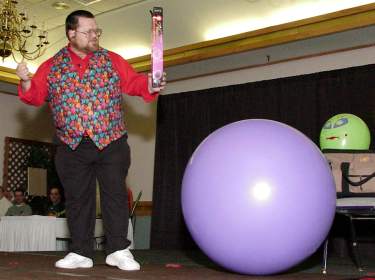
- I was asked to give a guest lecture in the anatomy course at the university here. My balloons made wonderful props. I used a bubble and a high bounce ball inside a 130 to demonstrate the difference between a firm nodule under the skin and a fluctuant (filled with fluid) nodule. They looked the same (made the bubble from a purple 130 and put a ball into the same 130 so both were covered with purple then took them out and put them both into a yellow 130 cut off at both ends to be about the size of a hot dog.. A great hands on demo and a really fun toy (when you throw it to the ground on the ball side it shoots up in crazy directions. My kids loved it. I also made a T. Myers “Beeker” (yellow with blue lips and a red bow tie crazy hat) and we went through the physical findings (jaundice, bulging eyes, tacky tie or goiter, and lack of oxygen causing blue lips) Possible diagnosis: he was either hyperthyroid or a nerd. What a kick.
- I am a physician, and a balloonist, and over the past several years, I have devised methods to demonstrate medical pathology. I can use balloons to demo just about every real surgical procedure, even open heart surgery, including harvesting vein grafts and doing the actual bypass procedure all with a different variety of balloons. I have performed this procedure on a large variety of television shows and also in the newspapers.My goal is to get my own television show to teach people about different medical procedures. I believe this has given ballooning a very positive outlook. I have found this very useful for patient education. I have performed before large groups of individuals and patients, with a very positive response. It has taken me around 5 years to perfect my techniques and I have gotten other doctors help on many of the intricate surgical procedures. The problem always is that people always have a large amount of personal medical questions which are at times difficult to answer and need my medical knowledge to gain believability. This very serious side a ballooning has given balloons a very serious side and I am working on a book, “Balloons In Medicine”, which I expect to market to the medical community. I feel this book would also be of great interest to my fellow balloonists, who I consider very dear friends.
- I’ve been known to make models of organic compounds during the slower moments of O-Chem labs. It’s a great tool for bringing 3 dimensional problems to life.
- I can easily see using balloons to talk about basic evolution, as things slowly start to form shapes.
- Take a bell jar connected to a vacuum pump. Inside the bell jar put a round balloon. Turn on the pump. The demonstration shows the balloon inflating as the vacuum pump worked. Next make a balloon dog for the demonstration. This goes down really well – all the students can’t wait to see the dog blown up. The whole laboratory filled with cheers when it did!!
- Get some liquid nitrogen and drop a balloon dog into it. The liquid nitrogen is so cold that it will condense all gaseous oxygen and nitrogen in the balloon, causing the animal to shrivel up. If you then carefully remove it and set it on the table, it will re-inflate in front of your eyes as it warms up, and the twists will stay intact.
- A quote from “;The Art and Science of Lecture Demonstrations”; by Charles Taylor. Dr. Taylor is a leading exponent of physics demonstrations. In talking about ‘Very portable demonstrations’ he says: “… but there are other small demonstrations that can easily be carried. One of my favorites uses just a handful of balloons; I use it when I am asked to talk about the nature of physics, possibly at a careers convention or a similar occasion. The discussion starts with the origin of various colors, goes on to discuss the reasons why rubber can stretch to such an extent, the cooling effect when a stretched balloon is allowed to contract suddenly, the behavior of the gas inside when a balloon is blown up, the musical (?) sounds that can be produced by allowing air to escape through the double reed formed by stretching the neck and finally the jet propulsion effect when the balloon is released. Although this is so trivial that it can hardly be classed as a demonstration, I have nevertheless been surprised at how many people have reminded me of it on subsequent meetings. It clearly helps to fix the ideas in the mind.”
- A collection of ideas for demonstrations using balloons has been put together by members of the Physics Instructional Resource Association, (PIRA)
Balloons as Rewards
- I work as a substitute teacher in 15 different elementary grade schools. I always tell my classes that the three hardest working students, those who show the best effort, will get some kind of a balloon figure. It has been a godsend because many times the teacher will leave me a note saying to watch out for Paul or Bobby because they are the worst of the bunch, or the toughest to keep quiet, but I have found that my reward system has made them the angels of the classroom, and oftentimes, Paul of Bobby gets 1st prize because they try so hard. In fact the teachers will often ask the students which sub they want to have when the teacher will take a day off, and many times the kids will ask for the balloon man because they want to get that reward.
- I have found balloons to work in really well with teaching… especially substitute teaching. 🙂 “Okay, everybody shut up and untie me and I will make some balloons for you.”
SKB 09/13/96
SKB 11/17/96
SKB 12/08/96
SKB 10/20/97
SKB 08/21/98
SMB 11/12/99